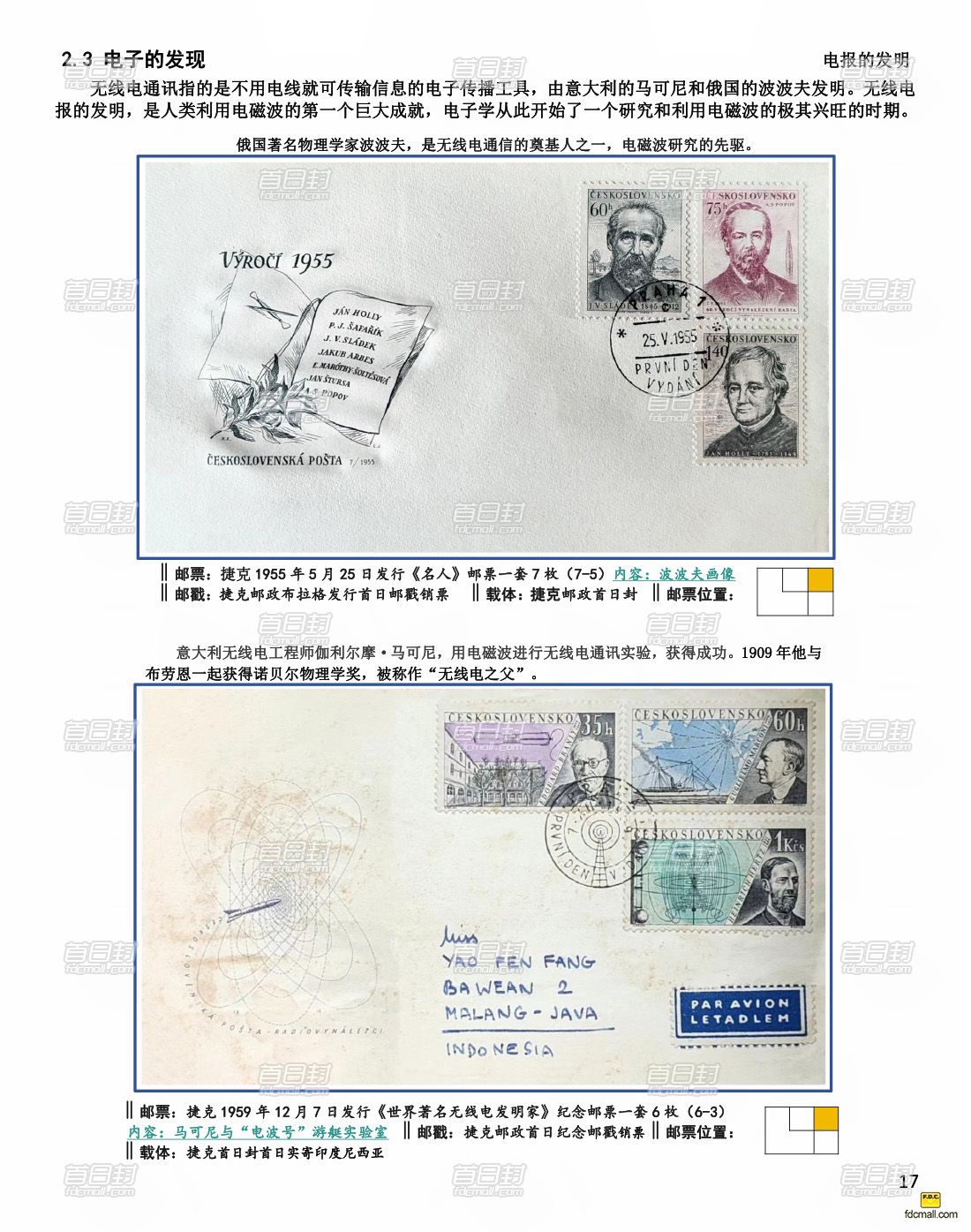
2.3.电子的发现:电报的发明:无线电通讯指的是不用电线就可传输信息的电子传播工具,由意大利的马可尼和俄国的波波夫发明。无线电报的发明,是人类利用电磁波的第一个巨大成就,电子学从此开始了一个研究和利用电磁波的极其兴旺的时期。俄国著名物理学家波波夫,是无线电通信的奠基人之一,电磁波研究的先驱。意大利无线电工程师伽利尔摩·马可尼,用电磁波进行无线电通讯实验,获得成功。1909 年他与布劳恩一起获得诺贝尔物理学奖,被称作“无线电之父”。
2.3. Discovery of the Electron & Invention of the Telegraph: Radio communication refers to electronic communication tools that transmit information without wires, invented by the Italian Guglielmo Marconi and the Russian Alexander Popov. The invention of the wireless telegraph marked humanity's first major achievement in utilizing electromagnetic waves, ushering in an extremely prosperous era of research and application of electromagnetic waves in electronics. The renowned Russian physicist Alexander Popov was one of the pioneers in establishing radio communication and a trailblazer in the study of electromagnetic waves. The Italian radio engineer Guglielmo Marconi successfully conducted experiments in wireless communication using electromagnetic waves. In 1909, he, along with Karl Ferdinand Braun, received the Nobel Prize in Physics and is known as the "Father of Radio."
fdc80-17
|
![首日封网 [集邮 邮票 首日封 实寄封 原地封 纪念封] China First Day Cover](data/attachment/common/template/boardimg_20250825g97sqpm5.png)

 IP卡
IP卡 狗仔卡
狗仔卡
 提升卡
提升卡 置顶卡
置顶卡 沉默卡
沉默卡 喧嚣卡
喧嚣卡 变色卡
变色卡 显身卡
显身卡


